by katie | Jan 19, 2015 | Blog
Maggie Orth’s Pileblocks was in a journal I was reading.
I have always been intrigued by interactive textiles; Textiles are beautiful tactile objects that need to engage the senses to be enjoyed as much as possible. Sight, touch, sound and even smell are important to fully enjoy textiles. I have not yet come across textiles that engage the sense of taste but would be intrigued to find a piece that does. It is important for me to experience weave with the first four senses and I think this is also important for anyone to be able to experience.
This interest drew me into Maggie Orths work, pictured below. In this piece she using LEDs to create patterns of light throughout the woven cloth. She used a double cloth structure within the weave and conductive yarns. When someone touches the grey areas light is transmitted through the cloth and the colour of the back hidden structure is revealed.
This interactive nature of woven textiles is something I would like to explore further within my own work.
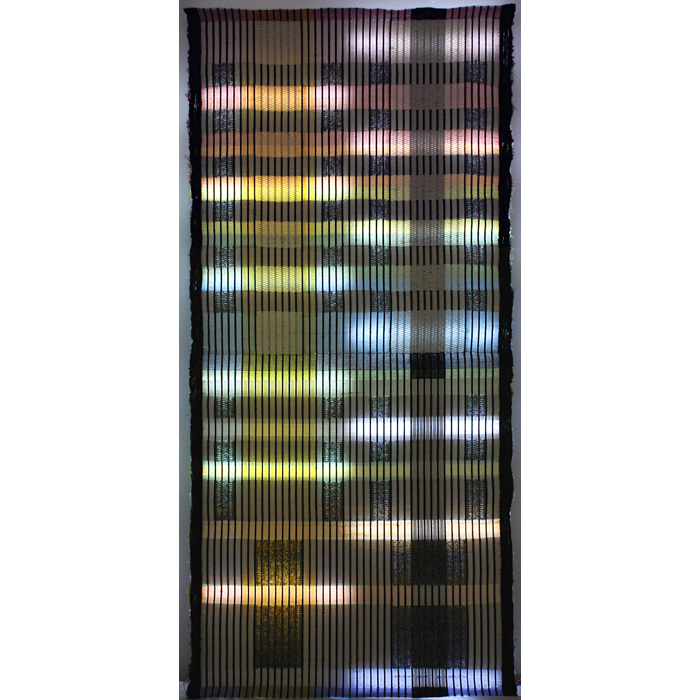
http://www.maggieorth.com/index.html
by katie | Jan 10, 2015 | Blog
I came across the weaver/artist Andrea Donnelly in Selvedge Magazine. I love the way her work is about the technical processes of weave and dying but they are also beautiful pieces of art.
She creates a range of scarves, branded Little Fools, which are woven and dyed by hand using luxury yarns. She uses an Ikat process to create the different colour effects, which is something I have enjoyed using very much within my own work.
She also trained as a fine artist which shows in her other work where she puts imagery on to woven cloth. At first it seemed like she used an Ikat technique for this too but this is not the case. For her pieces of artwork she weave a plain fabric and paints the image on top of this while the warp is still attached to the loom. Once dried and fixed she then carefully deconstructs the weave back in to it’s original warp and weft before reweaving it back together. Sometime she uses entirely different images to put back together and other times she used this technique to create a mirror image, this is shown in her work looking at ink blots.
She also studied Psychology and her strong interest in how the mind works shows strongly throughout her art.
To understand her processes more, have a look at her video: http://vimeo.com/49450900
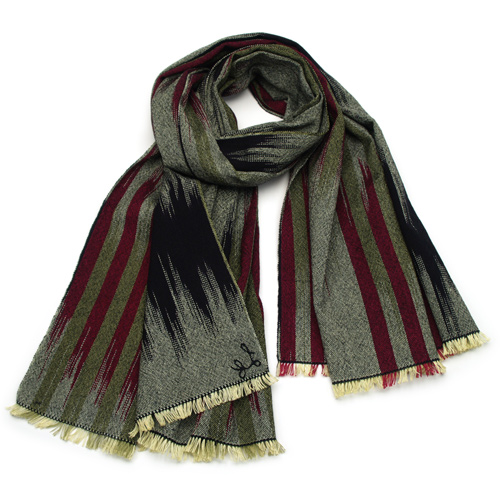
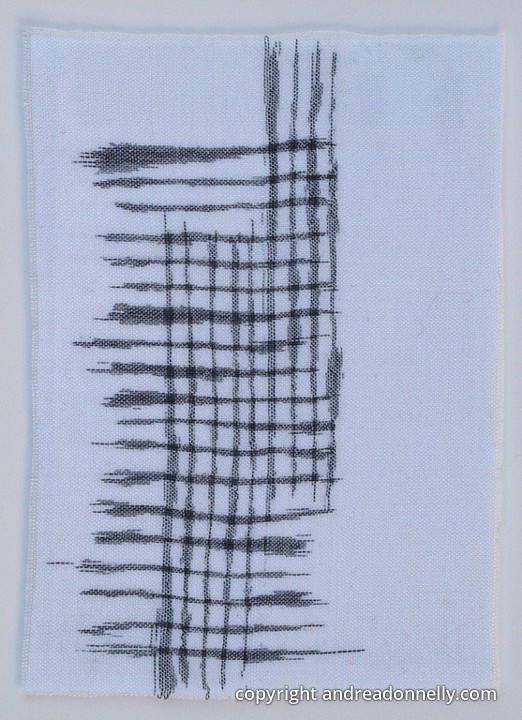
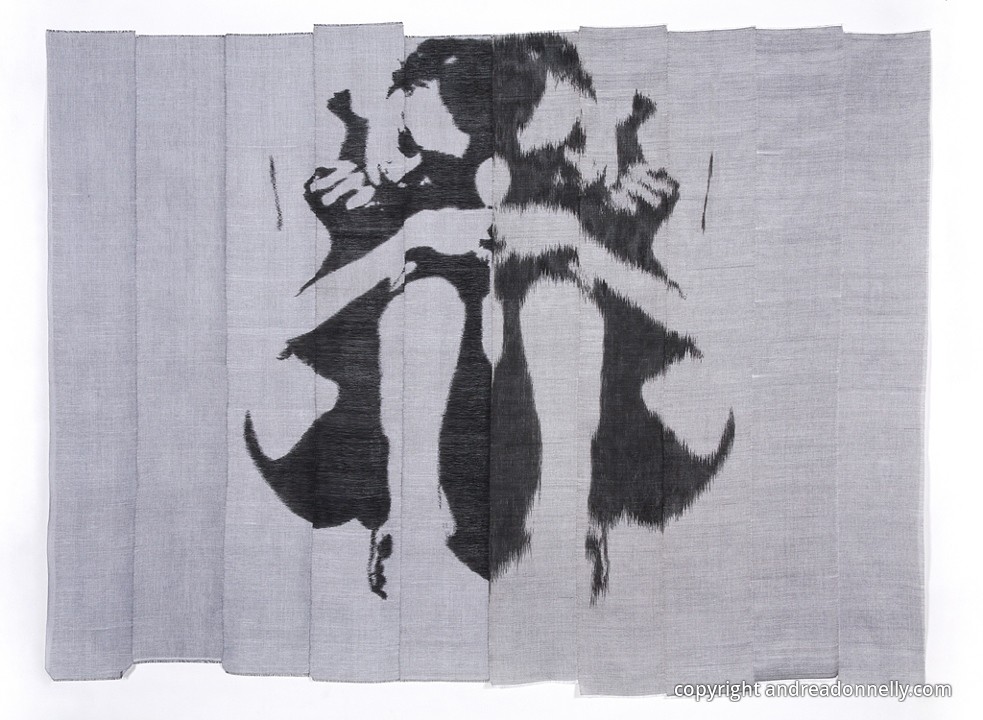
http://andreadonnelly.com/home.html
http://littlefooltextiles.com/
by katie | Oct 12, 2014 | Blog
Chiharu Shiota is a Japanese artist who mainly focuses on creating installation and performance artwork. She often uses everyday objects to explore the relationship between people and their possessions, and the memories embedded in them. She is also interested in exploring the relationships between past and present, and life and death. She uses objects such as shoes, suitcases, doors, keys and windows with threads to represent how the objects are entwined with our memories.
The picture below show her installation ‘Dialogue from DNA’ in which she uses four hundred individual shoes connected to a single point by four miles of red thread. Each shoe was donated by a member of the public along with a message describing the memories they associate with the shoe.

http://www.chiharu-shiota.com/en/
http://www.spoon-tamago.com/2014/09/29/chiharu-shiota-over-the-continents/
by katie | Sep 28, 2014 | Blog
I recently came across these shelves by Mat Brown, they are amazing. Being a designer he has an eye for potential and so when he came across a piece of oak that was cracked and had woodworm he knew it would make beautiful shelves. He took this wood and filled the cracks with coloured resin, giving the whole thing a good sanding/oiling to finish. The colour in the resin glows in the dark, in the picture below you can see how luminous the resin looks.
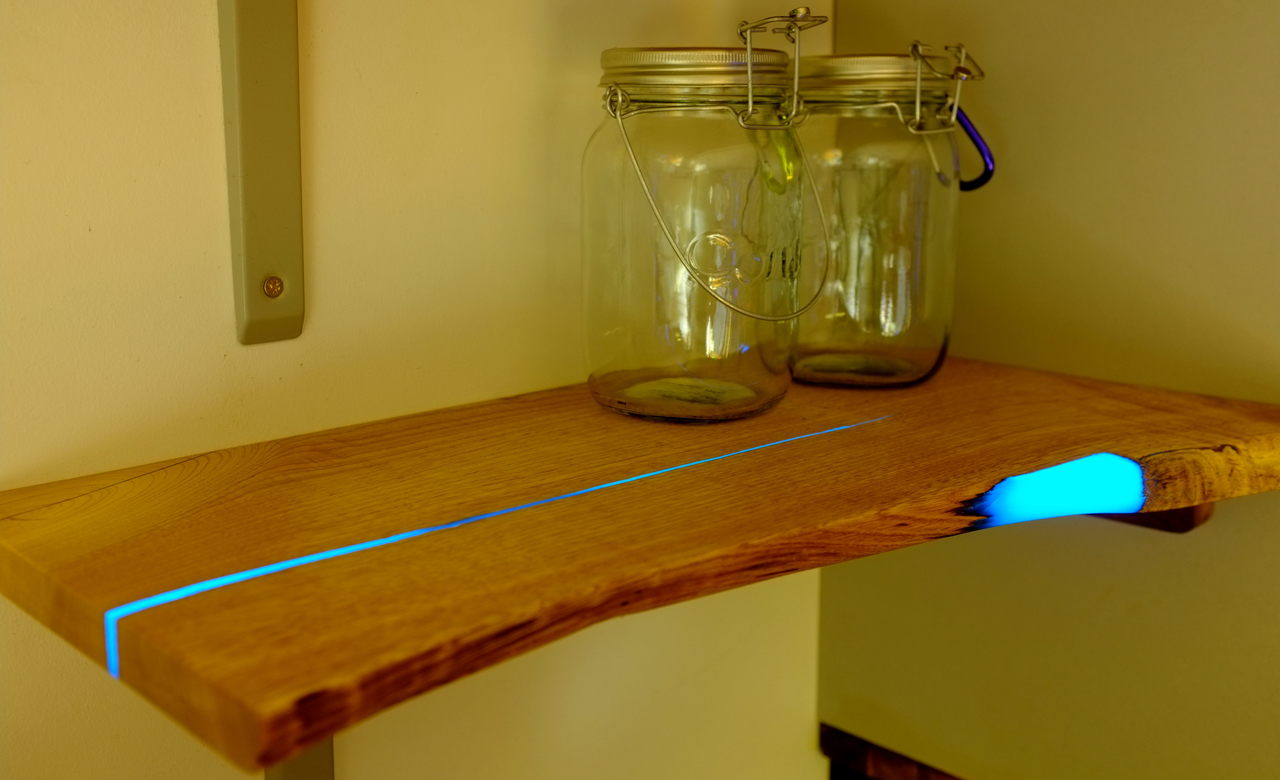
After seeing the shelves I had to investigate the rest of the work he does as a designer. He owns Shinium which makes beautiful jewellery from various woods, metals and resin. It is clear that everything he makes is mde with passion and a huge amount of skill.
Check out his website/blog to see more about the shelves and jewellery he makes. http://shinium.eu/
by katie | Jun 22, 2014 | Blog
I got the chance to go to three of the big London degree shows – Chelsea College of Arts, Central Saint Martins and The Royal College College of Art. It was a very inspiring day full of beautiful textiles, art and design.
Each university seems to have its strengths:
Chelsea College of Art – the knit was very inventive and creative. Having specialised in weave, I don’t know much about what can be achieved technically with knit and was very impressed. Each knit student’s work was so different from the next. I also found that a lot of the knit looked like a woven fabric with the yarns and textured used.
Central Saint Martins – I loved the experimental nature of the weaves, although the more traditional weaves were beautiful too. I found myself drawn towards the more natural, textural work and remembered my love of rust.
Royal College of Art – or course this work was all MA courses but I was completely blown away with what I saw across a multitude of disciplines. Again the weave was very experimental in approach. Here all of the students were present next to their work giving me the opportunity to talk to them about what they have been doing. There was a variety of different things with a student weaving copper and rusting it, weaving sheer fabrics, woolen jacket fabric, even mixing knit and weave to produce interior fabrics. Not only was the textiles incredible but the jewellery and ceramics were just perfect. If only I was rich enough to have bought a few pieces.
There were a few trends that seemed to feature across the three shows… bonding of fabrics, particularly for waterproof fashion. Many fabrics knitted and woven fabrics were bonded with a plastic for outerwear, or they were bonded with other fabrics to produce a thicker, stiffer fabric for a 3D interpretation. I also noticed a lot of linen used, this is something I have been drawn to recently. I haven’t woven with linen before but I will definitely be giving it a go soon. Within the weave fabrics and some knit there was a lot of hairy yarns woven amongst smooth yarns and then brushed in areas to create either stripes or patches of long, fibrous hairs.
In terms of the print, I found that the print was not what I expected. A large majority of it was not what I would call ‘traditional’ print such as screen printing or digital printing on flat fabric. I was surprised how much 3D printed was at the shows, in terms of plastic 3D structures. Many of the print pieces were fabric with a3D pattern or holes. The less ‘traditional’ print was really interesting.
Looking forward to the shows next year!
by katie | Mar 9, 2014 | Blog
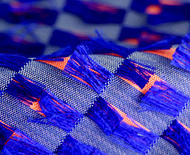
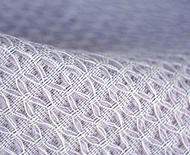
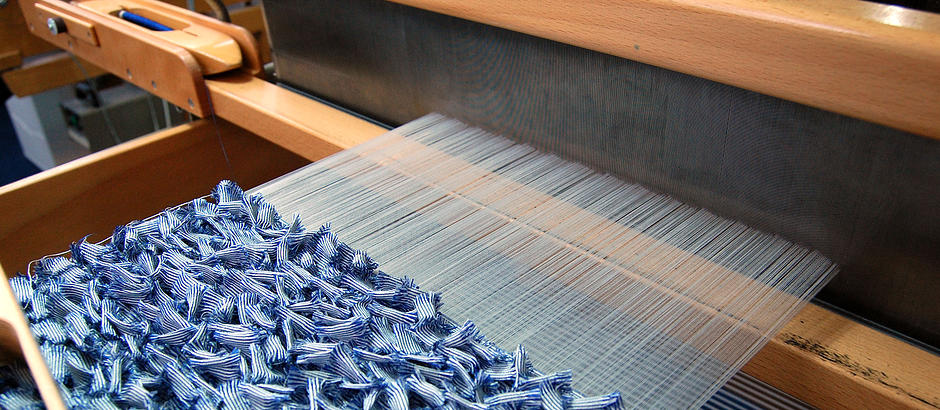
Dash and Miller only started up in 2009, two women brought together their weave skills, both traditional and industrial. The fabrics start as samples on a traditional handloom and are then sent to a British mill for production. The fabrics are designed for fashion, incorporating the latest trends. The website is well worth a look (see the link below).
http://www.dashandmiller.com/