by katie | Jan 10, 2013 | Blog
When I think of tartan I think of a coloured cloth, where the colour is in horizontal and vertical bands, causing areas of mixed colours. After taking on a commission in which the customer wanted a tartan pattern I decided I should probably gain more information about the colour, structure and pattern of tartan. If I could find out the ‘rules’ for traditional tartan I could then create a contemporary fabric using traditional ideas.
I found that originally tartan was woven using wool and did not have to be patterned at all. . In 1746 tartan was banned by the government in order to attempt to get rid of the Gaelic culture, although this ban was lifted in 1782. When there was colour the yarn was dyed using natural dyes, therefore the tartan was associated with a region or district, rather than a Scottish clan or family. It wasn’t until the middle of the nineteenth century that these tartans started to be associated with particular clans.
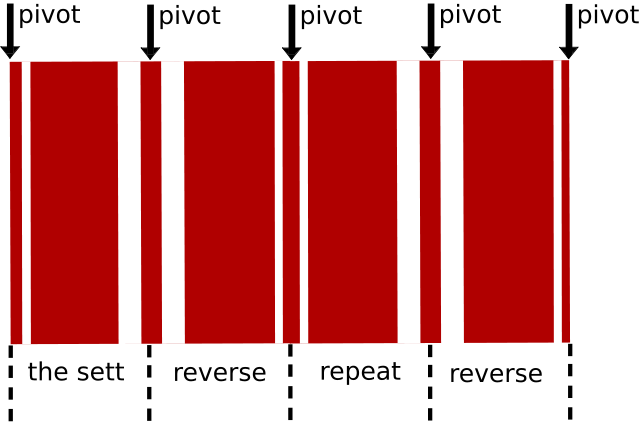
When I first started looking at tartans I saw that the all follow the same format. The diagram shows the construction of tartan. There is a sett, which is repeated and reversed throughout the cloth at certain pivot points. It doesn’t particularly matter on the structure of the original sett, as long as the regular pivots are used it will be a tartan. The weft is woven using exactly the construction as the warp.
http://en.wikipedia.org/wiki/Tartan
http://www.tartandesigner.com/tartan/
http://www.tartans.scotland.net/
by katie | Jan 10, 2013 | Blog
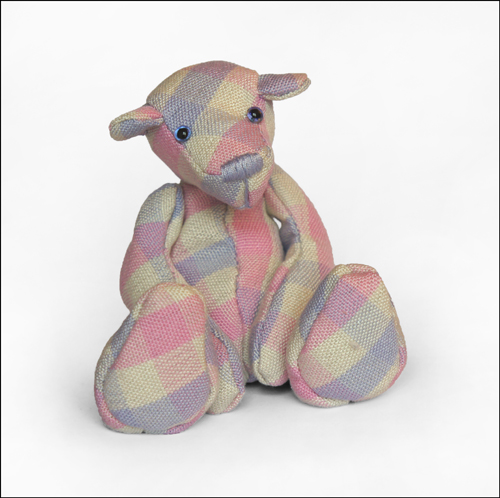
This is Tilly. She is made from mercerised cotton in subtle pink, purple and white. The check and plain weave mean the colours mix at regular intervals. I chose to place the teddy bear pattern pieces on the fabric at a 45 degree angle so that I didn’t have string verticals/horizontals, it helps create a soft feel. The glass beads inside create a good weight and firm texture.
by katie | Dec 10, 2012 | Blog
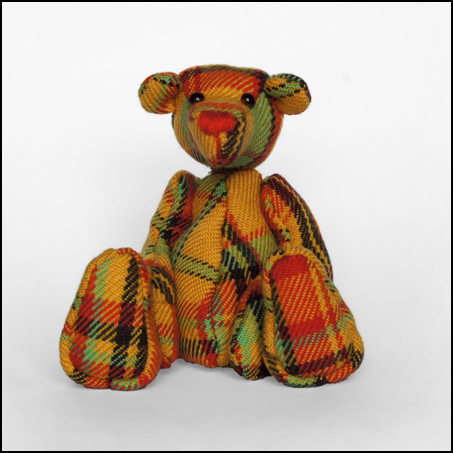
This teddy bear in was a bespoke order from customer who wanted to give her grown up daughter something extra special for Christmas. With each bespoke order I discuss with the customer how they would like the bear to look, colour, material, pattern etc. For this one her daughter loves the countryside so we went for a tartan pattern using wool yarn to create that traditional country feel. To put a contemporary twist I used a non-traditional tartan pattern and bright but warm colours. After initial ideas from the customer I did further research into tartans and colour palettes. I really pleased how the colours work together, try contrast well to enhance the tartan.
by katie | Dec 10, 2012 | Blog
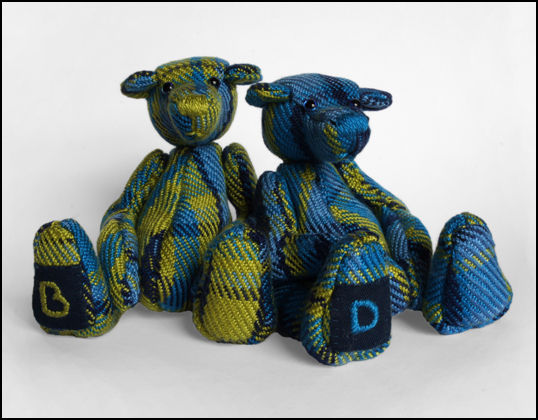
These two teddy bears were a commission for a lady who wanted a pair of teddy bears for her two grandchildren who are both under three years old. She wanted to give them something special for Christmas that they would cherish for years to come. They are both made from Tencel using a twill weave and contemporary tartan pattern. To make them look like a pair I used the same yarn for each but changed the composition of the tartan and proportion of colour. To make them even more personalised and special to each child I embroidered the first letter of their names on to the bottom of the foot.
by katie | Nov 29, 2012 | Blog
Tencel yarn is what most of my teddy bears are made from. I use it because it is incredibly soft, strong and comes in a gorgeous range of colours. Tencel is made by Lenzing Fibres and is the brand name for lyocell. It is a man-made fibre made from wood pulp cellulose. It is a very environmentally friendly fibre, fully biodegradable, and is produced using a ‘closed loop’ system, which means that the solvent used is continually re-used minimising pollution. The trees used to make Tencel are grown in sustainable tree farms on land which is not suitable for crops or grazing. Tencel is said to be as strong as polyester, as soft as silk, as absorbant as cotton and as cool as linen. This makes a versatile fibre, great for a wide range of products, from clothing to home accessories. It’s softness, strength and environmentally friendly production makes it an ideal fibre for my teddy bears.
by katie | Nov 21, 2012 | Blog, Showcase
I am very excited to be able to say that I am now on the Made By Hands of Britain website. It will be a great place to sell my teddy bears and bespoke, made to order teddy bears too.
I was honoured (and surprised) when Gillian approached me and asked me to be a part of Made By Hands of Britain. It was great to know somebody had noticed and like my teddy bears. It has definitely given me a boost in confidence.
by katie | Nov 19, 2012 | Blog
I have been asked a few times now why I make teddy bears. many weavers make scarves, throws, cushions etc. But I don’t. This is something I have been thinking about because I don’t normally have much of an answer. I don’t make the usual items because I want to make something special and stand out as an individual with a unique product. Making teddy bears is something I have always wanted to do, I found courses but they were always so expensive and in difficult to reach places. While at uni I gained the confidence to make a teddy bear myself, with my woven fabrics. The shop bought teddy bears I have at home each has a special memory attached to it. They remind me of a special place, event or person. I make teddy bears because I want to make a product that is treasured, that is going to be special to my customer, not something that will be worn for a a while and eventually discarded. Weaving the fabric for the teddy bear and being able to put a letter/initial/date on the makes each one truly individual.
I also love the fact that I am making a traditional product, using traditional techniques and processes but my use of colour, yarn and weave makes it a contemporary product.
by katie | Oct 13, 2012 | Blog
I have made my first sale! Arthur was bought through Perrynelvill.com just after I was shown on Paul Martin’s Handmade Revolution. I didn’t think I would sell any. I have faith in my bears, they are a great product at a reasonable price, as far as I know there is nothing else like them for sale. To be able to sell them I knew I would have to make people appreciate them, realise how much work actually goes into them. I guess the programme did that.
by katie | Oct 12, 2012 | Blog
I was lucky enough to be chosen to be feature on a new craft programme on BBC2, Paul Martin’s Handmade Revolution. I felt honoured to be among such talented crafts people. The people chosen for the programme used a wide range of crafts including knitting, ceramics, weaving, woodwork, metal work, felting, millenary, the list goes on. Many of these people came form a non-craft background and used crafts as a release for their day to day activities. Some, of course, had done craft their whole life. The judges, Glenn Adamson, Mary Jane Baxter and Piyush Suri, were great. They were very honest with their comments about the work they saw and gave advice to some of the finalists about how they would develop their work.I was shocked to find out that I was chosen as a judges favourite on programme 5, One person was picked form each programme. As one of ten favourites for the series I have my teddy bear, Cedric, on display at the Victoria and Albert Museum, London, for four weeks from 15th October 2012.
Upon seeing the series I was really pleased that the producers put a real emphasis on the time and skill it takes to do some of the crafts. As well as showing some crafts which are more speedy in process. The public were encouraged to have a go at a craft, most crafts people can pick up fairly quickly and can start making things. Although it does take time and experience to learn the skills and understand the process/medium chosen to produce something of great quality. One of the things I find difficult is to explain to people how much time and skill it takes to weave fabric and then make teddy bears from it. On first glance they can seem expensive but for the time and skill that goes into each teddy bear they are a very fair price.
by katie | Sep 28, 2012 | Blog
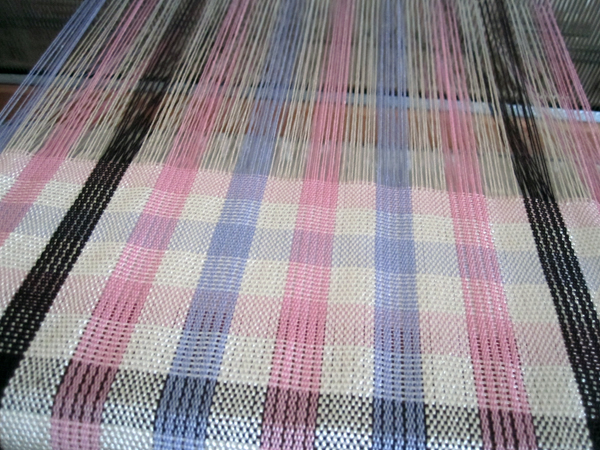
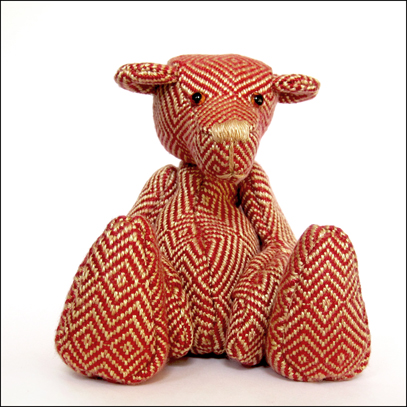
Sneak preview of my new fabric! I have contrasted a matt, soft cotton with a shiny viscose yarn to create a two textured, luxurious cloth. I have kept my colour palette very soft, using subtle pinks and purples with an accent of chocolate brown. I am constructing a few different fabrics using these colours. I will vary the structure and proportions of colour in each fabric.